
Here at Robert J. Feest & Associates, we value our relationship with you and the Insurance business you have placed with us and want to keep you informed about an upcoming change impacting the renewal of your Homeowners policy.
Due to the increase in weather-related claims in recent years, many insurance companies are implementing a separate deductible for Wind or Hail losses, which will become effective upon your policy renewal.

Understanding the Change
Your standard property deductible covers most losses, but the new Wind or Hail deductible creates a specific, separate out-of-pocket amount for damage caused by these events.
Where to Find It: Your standard deductible and your new Wind or Hail deductible amount can be found on your Home Declaration page under the Property Deductible section of your Homeowners Renewal Declarations page.
Read your policy every year so you are aware of any changes and updated coverage limits.
What is a Wind or Hail Deductible?
If there is damage to your home due to Wind or Hail, this deductible is the portion of a covered claim you would pay out of pocket. This deductible only applies to damage caused by Wind or Hail, including tree damage and debris removal. Your standard property deductible applies to all other covered losses.
Example
Suppose you have a $1,000 property deductible and a $2,500 Wind or Hail deductible on your insurance policy. If a hailstorm causes $15,000 worth of damage to your home, the Wind or Hail deductible would apply. This means you would pay your $2,500 deductible toward the loss, and your insurance company would cover the remaining $12,500.
(Note: This example is hypothetical, and the deductible amounts mentioned are not necessarily your actual deductible amounts).
How is a Wind or Hail
Deductible Determined?
The Wind or Hail deductible is determined based on the following factors:
Your Coverage A–Dwelling limit.
The location of your home.
The AGE of Your roof, and TYPE of Shingles you have on it.
The Wind or Hail deductible will be reviewed at each renewal to determine the minimum deductible amount for your policy. This amount could change at each renewal, so please review your Homeowners Renewal Declarations every year.
Important Roof Valuation Change
Additionally, if your roof is 10 years or older, many companies are changing your roof valuation from Guaranteed Replacement Value to a Depreciated Actual Cash Value basis. This is another crucial detail to check on your renewal.

Clean out those Clogged Rain Gutters BEFORE the snow flies!
Preventative Home Maintenance can help avoid costly roof claims and repairs.
Gutters are designed to direct meltwater away from your house. When they are clogged with leaves, debris, or already frozen solid, they become part of the problem rather than the solution.
Blocking Drainage: A clogged gutter prevents the melted snow (liquid water) from flowing off the roof and down the downspout. Instead, the water is trapped right at the edge of the roof, pooling on the eaves.
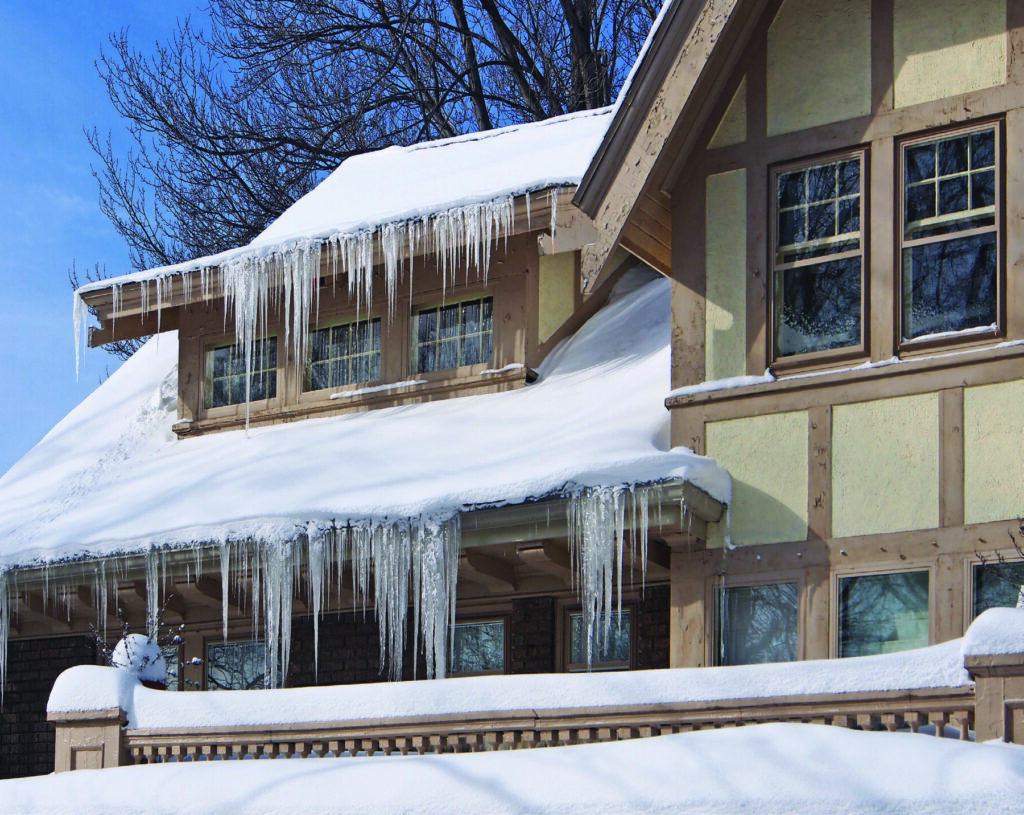
Fueling the Dam: This trapped, pooled water is the ideal starting point for an ice dam. As the water freezes, it forms a solid, non-porous barrier of ice in the gutter and on the roof edge. This ridge then acts like a dam, blocking any subsequent meltwater from draining. Long Icicles hanging off your Rain Gutters will also appear as the water in the gutter melts in the sun, and re-freezes quickly at night when the temperature drops.
Physical Damage: The sheer weight of a gutter packed with ice and trapped water can strain the fasteners, causing the gutters to sag, detach, or rip completely off the fascia board. This structural damage is often irreversible without professional repair or replacement.
The Destructive Freeze-Thaw Cycle
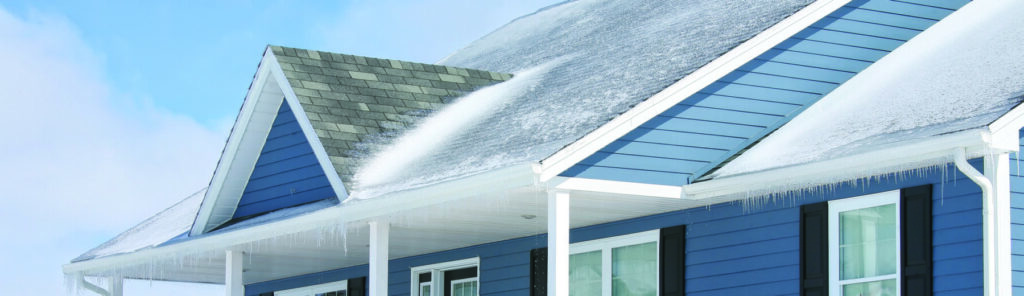
The combination of warm air leaking from the attic (the “melt”) and cold outdoor temperatures (the “freeze”) is the primary mechanism that destroys your roof structure.

How It Wrecks Your Roof
The most significant damage occurs when the trapped water backs up and penetrates the roof system:
Water Intrusion: Asphalt shingles are designed to shed water downward, not to withstand pooled water backing up underneath them. The trapped water works its way past the shingles, underlayment, and flashing, leading directly to the attic.
Insulation & Ceiling Damage: Once in the attic, the water soaks the insulation, rendering it ineffective and heavy. It then leaks through the ceiling, causing brown water stains, peeling paint, and eventually, saturated drywall that may collapse.
Wood Rot and Mold: Prolonged moisture inside the roof deck, rafters, and walls creates a perfect environment for wood rot and toxic moldand mildew growth, which compromise the structural integrity of your home and pose significant health risks.
Shingle & Flashing Damage: The constant presence of freezing and expanding water can lift and loosen shingles, crack roof flashing (the metal seals around chimneys and vents), and essentially destroy the integrity of your roof surface, making it vulnerable to future leaks even after the winter is over.
We Are Here to Help!
With all the coverage changes and updates, insurance can be extremely confusing, but we are always here to answer your questions and help you sort through it.

Since 1995, we have always been a Customer Relationship Oriented agency, with an emphasis on super-outstanding service, and that will never change. THAT is who we are, and THAT is what we DO!Be sure to call our office, or email us if you have additional questions about this change and how it applies to your specific policy.

Robert Feest
Robert J. Feest Insurance Agency
262-641-0644
www.RFeest.com

This article is from the
EY November 2025 Issue